
 Ottawa – Beginning today, in Catholic dioceses/eparchies across Canada, Bishops will issue locally the updated and expanded national guidelines for the protection of minors in Canada. Entitled Protecting Minors from Sexual Abuse: A Call to the Catholic Faithful in Canada for Healing, Reconciliation, and Transformation, this document of the Canadian Conference of Catholic Bishops (CCCB) was unanimously adopted by the Bishops of Canada on September 27 during their 2018 annual Plenary Assembly. Since then, Bishops have taken time to familiarize themselves with its contents and to consider with their diocesan/eparchial staff how to ensure its implementation in their dioceses/eparchies as well as how best to inform and educate clergy, members of religious communities and lay personnel.
First and foremost, this document focuses on minors and vulnerable adults, whom Canada’s Bishops wish to protect from sexual violence. In addition to a clear delineation of procedures in cases of sexual abuse, it puts forward 69 recommendations inspired by nine lessons which Bishops have learned through their collective experiences over the past quarter century. Chief among these is that victims must come first. The document seeks not only to provide guidance for diocesan/eparchial protocols and policies as well as those for religious communities, but to stimulate a cultural transformation in attitudes about sexual abuse. The new guidelines apply to all Catholic clergy (Bishops, priests and deacons), as well as members of religious communities and also lay personnel who are working in Catholic parishes or Church organizations.
With their responsibility for the safeguarding of pastoral environments at the forefront of their ministry, and to ensure accuracy, depth, authenticity, rigour, and relevance, the Bishops in preparing the document involved input from a broad spectrum of contributors, including survivors, lay women and lay men, as well as professional consultants with experience and expertise in psychology, social work, child protection, and Church and civil law. The majority of the experts consulted also have specific experience in protecting minors and vulnerable adults from sexual abuse.
With this document, Canada’s Bishops reaffirm their commitment to continue improving practices in their dioceses/eparchies with an emphasis on long-term prevention and pre-emptive action. The document brings the CCCB’s existing guidelines (From Pain to Hope, 1992; Orientations, 2007) up to date with the latest laws in Canada and the most recent norms of the Holy See. Bishops will study and use the document to update diocesan/eparchial policies and protocols. In adopting the document, the Bishops also agreed to establish a special committee to assist the CCCB in keeping its policies up-to-date and to make recommendations on emerging questions.
The Bishops acknowledge that the implementation of a document of this magnitude will take time, but the focused and transformative actions which will come of it will protect minors and promote the healing of survivors. All of Canada’s Bishops hope that survivors of sexual abuse will read Protecting Minors from Sexual Abuse and see in it a real effort to listen and learn from them.
Additional Information
Introduction to Protecting Minors from Sexual Abuse: A Call to the Catholic Faithful in Canada for Healing, Reconciliation, and Transformation – https://youtu.be/71_KUyo3NkE
- This resource may be downloaded and printed without permission for personal and noncommercial use. For all other usage, please contact permissions@cccb.ca.
- The document is also available for purchase from CCCB Publications.
Media inquiries
To facilitate queries from the media, the Canadian Conference of Catholic Bishops (CCCB) recommends the following:
For inquiries pertaining to the content of the document Protecting Minors from Sexual Abuse: A Call to the Catholic Faithful in Canada for Healing, Reconciliation, and Transformation, contact:
Lisa Gall
Communications Coordinator
Canadian Conference of Catholic Bishops (CCCB)
E-mail at communications@cccb.ca
Phone at 613-241-9461, ext. 225
For inquiries pertaining to the implementation of the document in Canadian dioceses/eparchies, contact the local diocese/eparchy directly here.
 (CCCB – Ottawa)… His Holiness Pope Francis has accepted the resignation of the Most Reverend André Rivest as Bishop of the
  In response to the Rohingya persecution in Myanmar, The Canadian Catholic Organization for Development and Peace – Caritas Canada has launched an
  (CCCB – Ottawa)… The Most Reverend Jacques Landriault,
  (CCCB – Ottawa)… The Canadian Conference of Catholic Bishops (CCCB) intervened on 30 October 2017 before the House of Commons Standing Committee on Justice and Human Rights concerning clause 14 of Bill C-51, “An Act to Amend the Criminal Code and the Department of Justice Act and to Make Consequential Amendments to Another Act”. Under clause 14, the Bill proposes the removal of Section 176 (1, 2, 3) of the Criminal Code of Canada, which currently makes it an indictable offence to obstruct or cause violence to an officiating clergyman or minister as well as to disturb religious worship or gatherings. The oral interventions were brought forward by the Most Reverend Lionel Gendron, P.S.S., Bishop of Saint-Jean-Longueuil and President of the CCCB and His Eminence Thomas Cardinal Collins, Archbishop of Toronto. The two Bishops were accompanied by Mr Bruce F. Simpson, a partner with Barnes Sammon LLP specialized in criminal law.
 Cardinal Collins noted that “This is the only section of the Criminal Code that explicitly references protection for religious communities”, adding “[it] has been referenced in court cases in the past where judges have recognized that freedom of assembly and freedom of association, rights protected in the Charter, could be rendered meaningless without the protection of section 176….” Bishop Gendron went on to point out that “Section 176 emphasizes and reinforces our shared belief in and respect for the freedom of religion and maintains an indispensible link between the Criminal Code and the protection of fundamental human rights.” He reminded the Committee that “The human person understood as a seeker of truth is the basis for religious freedom, for freedom of conscience, and indeed for freedom of speech.” Concerning the protection given to ministers of religion in section 176, Bishop Gendron clarified that “to protect them from being obstructed in the performance of their duties or from assault is not to protect some ostensible elite status; it is to protect the community of faith by ensuring that the exercise of religious freedom is not impeded by acts of violence or threats which are directed against its faith leaders.”
 (CCCB – Ottawa)… The Canadian Conference of Catholic Bishops (CCCB) intervened on 30 October 2017 before the House of Commons Standing Committee on Justice and Human Rights concerning clause 14 of Bill C-51, “An Act to Amend the Criminal Code and the Department of Justice Act and to Make Consequential Amendments to Another Act”. Under clause 14, the Bill proposes the removal of Section 176 (1, 2, 3) of the Criminal Code of Canada, which currently makes it an indictable offence to obstruct or cause violence to an officiating clergyman or minister as well as to disturb religious worship or gatherings. The oral interventions were brought forward by the Most Reverend Lionel Gendron, P.S.S., Bishop of Saint-Jean-Longueuil and President of the CCCB and His Eminence Thomas Cardinal Collins, Archbishop of Toronto. The two Bishops were accompanied by Mr Bruce F. Simpson, a partner with Barnes Sammon LLP specialized in criminal law.
 Cardinal Collins noted that “This is the only section of the Criminal Code that explicitly references protection for religious communities”, adding “[it] has been referenced in court cases in the past where judges have recognized that freedom of assembly and freedom of association, rights protected in the Charter, could be rendered meaningless without the protection of section 176….” Bishop Gendron went on to point out that “Section 176 emphasizes and reinforces our shared belief in and respect for the freedom of religion and maintains an indispensible link between the Criminal Code and the protection of fundamental human rights.” He reminded the Committee that “The human person understood as a seeker of truth is the basis for religious freedom, for freedom of conscience, and indeed for freedom of speech.” Concerning the protection given to ministers of religion in section 176, Bishop Gendron clarified that “to protect them from being obstructed in the performance of their duties or from assault is not to protect some ostensible elite status; it is to protect the community of faith by ensuring that the exercise of religious freedom is not impeded by acts of violence or threats which are directed against its faith leaders.”
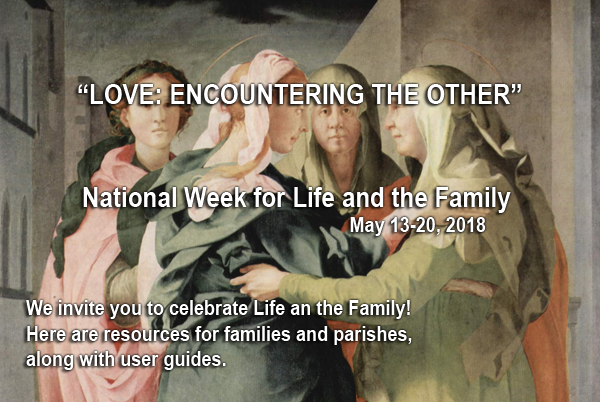 The National Week for Life and the Family will be celebrated across Canada, the 13 to 20 May 2018, from the Solemnity of the Ascension of the Lord to Pentecost Sunday. Ascension Sunday this year also coincides with Mother’s Day. For the sixth consecutive year, the Canadian Conference of Catholic Bishops (CCCB) is offering dioceses/eparchies, parishes as well as Catholic organizations and associations groups possible resources and options for planning and organizing local activities. The theme for 2018 is “Love: Encountering the Other”. The resources have been prepared by the
  As part of the
 At the reception following the Mass, Bishop Crosby who was then CCCB President spoke of the
 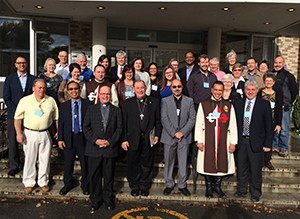 The 2017 Forum for Canadian national Catholic movements and associations was held in Châteauguay, Quebec, at Manoir D’Youville, 6-8 October 2017. Hosted every three years by the Standing Committee for Relations with Catholic Movements and Associations of the Canadian Conference of Catholic Bishops (CCCB), this provides a unique opportunity for national Catholic organizations to share and discuss their activities and charisms with one another and with the Bishops on the Standing Committee. This year, the theme was “Co-workers in the vineyard”. The gathering brought together representatives from over 25 national Catholic organizations from across Canada who engaged in three major discussions: the formation of leaders in the Church, the different faces of social, material and spiritual poverty present in Canada, and the use of social media in the Church’s mission of evangelization.