The Catholic Organization for Life and Family (COLF) has written to Prime Minister Stephen Harper on the government’s recent decision to provide funding to the International Planned Parenthood Federation. The letter was signed by the Most Reverend Gerald Wiesner, O.M.I., in his capacity as Chairman of the COLF Board of Directors. The complete text of the letter is on the COLF website.
Archives
Letter to the Chargé d’affaires and Head of Mission of the Embassy of the Islamic Republic of Iran from Archbishop Brendan M. O’Brien, Chairman of the CCCB Human Rights Committee, regarding Pastor Youcef Nadarkhani
Archbishop Brendan M. O’Brien, Chairman of the CCCB Human Rights Committee, has written to the Chargé d’affaires and Head of Mission of the Embassy of the Islamic Republic of Iran. The CCCB is requesting that
New Website for French Sector Office national de liturgie (ONL)
The French Sector Office national de liturgie (ONL) now has its own website http://onl.cecc.ca/, which is also accessible from the French-language home page of the CCCB website.
The new website includes information about the French Sector Commission for Liturgy and the Sacraments, ONL publications, a number of documents by the Commission and also the liturgy of the day.
In addition, the new website provides an outline in French of the Canadian adaptations for the General Instruction of the Roman Missal as approved for
In 2007, the English Sector National Liturgy Office launched its website with the electronic version of its quarterly Newsletter. Since then, the site has continued to be developed. It had recently included a link to new Canadian website for the Roman Missal, www.romanmissal.ca.
Pastoral Letter on The Revised Roman Missal and its Liturgical Norms
(CCCB –
That same day, Canadian Catholics are to begin using the revised English-language translation of the Roman Missal, which is being published by the Canadian Conference of Catholic Bishops (CCCB). French-speaking Catholics will continue to use the current translation of the Roman Missal until their new translation is available. The French Sector Bishops of Canada are currently working on this project. It is part of a long and intensive process expected to continue for several more years.
The present revision follows an announcement in 2000 by Pope John Paul II there would be a “third typical edition” of the Roman Missal. The revised Latin text of the Missal was published by the
In order to assist in introducing and understanding the revised liturgical norms, as well as the revised English-language translation, CCCB President Bishop
In his letter, Bishop Morisette recalls that the introduction of the revised liturgical norms is a moment of grace that invites all the faithful to deepen their unity as the body of Christ. “On behalf of the Bishops of Canada,” he writes, “I invite everyone to embrace the new norms and welcome the new translation. In our communal celebrations, the words, gestures and postures we use at worship are an important sign of our unity and harmony.”
The CCCB has produced various resources to aid in introducing the liturgical revisions, including:
- Two shortened versions of the pastoral letter, retitled as “Message to all the Faithful”, which focus on the specific liturgical changes in each of the two linguistic sectors;
- Four templates of the pastoral letter so it can be distributed as bulletins or news letters to specific groups.
The above resources, including the pastoral letter from the CCCB President, are available on the CCCB website, www.cccb.ca.
Joint meeting held of CCCB Standing Committee on Development and Peace and CCODP Liaison Committee
The CCCB Standing Committee on the Canadian Catholic Organization for Development and Peace (CCODP) met with the Liaison Committee of the CCODP National Council on September 19, 2011, at the
The delegates from Development and Peace as well as from the Conference of Bishops were pleased to have the opportunity to meet, and agreed to meet regularly several times a year. In addition, they indicated their openness to meet more often if special issues arose. As well as laying the groundwork for working together and future meetings, they agreed to issue joint communiqués after each meeting. Furthermore it was also agreed to establish an ad hoc working group to assist in reviewing several draft policy documents that are being prepared by CCODP.
The meeting clarified that both CCODP and the CCCB mutually agree it is important to involve local Bishops from the Global South in the dialogue, discussion and rapport that are part of development work. It was also agreed that when CCODP identifies questions or concerns about this, it will consult with the CCCB Standing Committee. Other points of discussion included the transitional role of the two Bishops who presently serve on the CCODP National Council; the importance of maintaining good relationships and good communications with all the Bishops of Canada; and an acknowledgement that the CCODP Liaison Committee needs to report to the CCODP National Council, just as the CCCB Standing Committee reports to the Permanent Council and Plenary Assembly of the Conference of Bishops. In turn, the CCODP National Council has its own responsibility for communicating with CCODP members across the country, just as the CCCB must involve each Diocesan Bishop in
Both committees look forward to their next joint meeting, possibly to be scheduled during February 2012, with progress reports to be exchanged by mid-October.
The members of the CCODP Liaison Committee are: Mr. Ronald Breau, New Brunswick, President of the Development and Peace National Council; Mr. Patrick Hogan,
The members of the CCCB Standing Committee are: Most Reverend John Boissonneau (Chairman), Auxiliary Bishop of
The Canadian Conference of Catholic Bishops established its Standing Committee on the CCODP following the October 2010 Plenary Assembly of the Bishops of Canada. The Standing Committee replaces the former CCCB Ad Hoc Committee for CCODP. It provides an ongoing mechanism for the Bishops to accompany and encourage CCODP, while also supporting the organization in its review of its decision-making and operating protocols, and facilitating communication and collaboration between the two organizations. In June 2011, the National Council of the Canadian Catholic Organization for Development and Peace formed a Liaison Committee to meet with the CCCB Standing Committee.
– 30 –
2011 CCCB Plenary Assembly
(CCCB –
The Plenary will also welcome invited observers and guests from a number of national Catholic organizations as well as from other Churches, together with accredited representatives from the media. The public session of the Plenary Assembly is on Monday, 10 a.m. to 5 p.m., 17 October, and on Tuesday, 9:15 a.m. to noon, 18 October. The Annual Report from the President of the CCCB and the daily liturgical celebrations will be broadcast live online and on television this year, thanks to the collaboration of the Catholic television channel Salt and Light.
The first part of the Plenary will include reflections on the Post-Synodal Apostolic Exhortations Sacramentum Caritatis (on the Eucharist as the source and summit of the Church’s life and mission) and Verbum Domini (on the Word of God in the life and mission of the Church). The Most Reverend Robert Le Gall, O.S.B., Archbishop of Toulouse, France, will lead these reflections, which will be followed by workshops for the Bishops.
The annual Plenary Assembly is also the occasion when the Roman and Eastern Catholic Bishops of Canada receive reports on the work over the past year by the Conference’s national and sectoral commissions and standing committees, as well as the Canadian Catholic Aboriginal Council.
The CCCB is the national assembly of the Bishops of Canada. It was founded in 1943 and officially recognized by the Holy See in 1948. After the Second Vatican Council (1962–65), the CCCB became part of a worldwide network of Episcopal Conferences, established in 1965 as an integral part of the life of the universal Church.
Salt + Light Television is currently available through Rogers Digital Cable, Cogeco Digital Cable and Mountain Cable in Ontario, Vidéotron Digital TV (Illico) in Quebec, EasLink Digital Cable in the Maritimes and across Canada through Bell ExpressVu, a satellite carrier.
– 30 –
Rules and regulations for journalists attending the CCCB Plenary Assembly
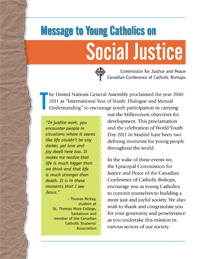
Message to Young Catholics on Social Justice
(CCCB –
”The Catholic Church shares all of humanity’s common quest for peace and happiness, and supports the efforts of individuals and groups working to eradicate poverty, illness, injustice, inequality, human rights violations, and environmental exploitation,” the message states. “This witness of solidarity flows from God’s love for humanity as revealed to us in Jesus Christ.”
The message includes brief testimonies from several young Catholics on why their faith in Jesus Christ has led to their engagement in social justice activities. The testimonies are from members of the Canadian Catholic Organization for Development and Peace (commonly known simply as Development and Peace), the Canadian Catholic Students’ Association, and Catholic Christian Outreach.
The Commission’s message is available on the CCCB website at www.cccb.ca. The text is formatted to be easily read and downloaded on smartphones or other portable digital devices.
The Canadian Conference of Catholic Bishops (CCCB) is the national assembly of the Bishops of Canada. It was founded in 1943 and officially recognized by the Holy See in 1948. After the Second Vatican Council (1962–65), the CCCB became part of a worldwide network of Episcopal Conferences, established in 1965 as an integral part of the life of the universal Church.
Pastoral letter to young people with same-sex attraction
Study guide now available
(CCCB –
Prepared by the Salt and Light Catholic Television Network, the study guide is a helpful tool to understand the Church’s position better on the issue of same-sex attraction. The guide defines important and commonly used terms, highlights key elements of the Pastoral Letter, and provides thought-provoking questions which can be used individually or in a group. This resource will be useful for Catholic teachers, pastoral workers, and young people themselves.
In its letter, the Commission offers various pastoral guidelines, in addition to expressing its “profound gratitude to all those who wisely and lovingly guide young people with a same-sex attraction: priests and pastoral associates, parents and educators.”
“Families, did you know? Love is calling your children”
Again this year, the Catholic Organization for Life and Family (COLF) is reaching out to Canadian families with its 2011 Message, “Families, did you know? Love is calling your children”. The new publication focuses on vocations, and is being released just after the recent celebration of World Youth Day in
The message recognizes that the young are searching for meaning and ideals, and wish to understand the meaning of their own special calling. COLF hopes to help parents, teachers, pastors and catechists respond to this search for a “mission in life”.
All the baptized, the message states, are called “at the hour of this new evangelization … to be witnesses to hope.” The text begins with a reminder that every child is “unique and irreplaceable,” and so also has a unique mission. It points out that children come to know and trust God in their family life, and so learn to love as Jesus did and to follow him. The message then looks at the paths of marriage, the ministerial priesthood, consecrated life and apostolic celibacy.
An initiative of the Canadian Conference of Catholic Bishops, COLF is co-sponsored by the Conference and the Supreme Council of the Knights of Columbus. It promotes respect for human life and dignity, and the essential role of the family.
Printed copies of the 2011 Message to Families can be ordered from www.colf.ca or by phoning 613-241-9461, extension 161.
Revisions of Roman Missal for use in Canada: CCCB issues Decree of Implementation
(CCCB – Ottawa)… On August 15, 2011, the Canadian Conference of Catholic Bishops (CCCB) published the Decree of Implementation for the General Instruction of the third typical edition of the Roman Missal for use in Canada. The new norms of the General Instruction will come into effect on November 27, 2011, in all English-language and French-language parishes and institutions in the country. The same day, the revised Proper Calendar for the Dioceses in Canada will also be implemented in conjunction with the revised General Instruction.
In addition, the decree confirms that the revised English-language edition of the Roman Missal approved for use in Canada, including the variations to the English-language translation of the Propers of the Mass, will also come into effect on November 27, 2011, which is the First Sunday of Advent. That same day, many other English-speaking countries will also be implementing their own revisions of the Roman Missal as approved by the Bishops of each country and confirmed by the Holy See.
By coincidence, the revised French-language marriage ritual which has been approved by the Bishops of Canada and confirmed by the Holy See will come into effect as well on the same day.
Last month, following the confirmation or recognitio of the Holy See, the CCCB published the Decree of Publication, dated July 15, 2011, for the revised English-language Roman Missal from the Publications Service of the Conference. The 1,480-page layout of the CCCB edition of the Missal is now with the St. Joseph Communications printing company. According to the production schedule, the Missal will be shipped to parishes and religious institutions as of November 10, 2011.
In accordance with the Instruction Liturgiam authenticam, no. 83, issued by the Congregation for Divine Worship and the Discipline of the Sacraments, and also the canonical vote by the Bishops of Canada, the Decree of Implementation and the Decree of Publication both stipulate that the new CCCB edition is the sole translation and version of the Missal authorized for use in English-language liturgical celebrations of the Roman Rite in Canada. Both decrees, signed by the President of the CCCB, Bishop Pierre Morissette, are available on the CCCB website under “Official Texts”.
On the Web
The English-language General Instruction of the third typical edition of the Roman Missal for use in Canada, including the adaptations for Canada, will be available shortly on the special CCCB website dedicated to the Roman Missal at www.romanmissal.ca. The French-language version of the adaptations to the General Instruction as approved for Canada will be accessible over the coming weeks.
In addition, a pastoral note will be sent to the Bishops of Canada, inviting them as of September 25 to authorize experimentation in their dioceses with the liturgical modifications required by the General Instruction and also with the sung responses for the new English-language translation of the liturgical texts in the Missal.
The Canadian Conference of Catholic Bishops (CCCB) is the national assembly of the Bishops of Canada. It was founded in 1943 and officially recognized by the Holy See in 1948. After the Second Vatican Council (1962–65), the CCCB became part of a worldwide network of Episcopal Conferences, established in 1965 as an integral part of the life of the universal Church.