– Message from the Holy Father
– Letter by CCCB President Bishop Pierre Morissette

COMMUNIQUE OF THE COORDINATION OF EPISCOPAL CONFERENCES IN SUPPORT OF THE CHURCH IN THE HOLY LAND
January 14, 2010, Jerusalem
At our tenth meeting in the Holy Land, Patriarch Fouad Twal reflected on the pilgrimage of Pope Benedict XVI in May 2009. In union with our Holy Father we call for justice and peace for all of the peoples of this land. We make his departing appeal our own:
“No friend of the Israelis and the Palestinians can fail to be saddened by the continuing tension between your two peoples. No friend can fail to weep at the suffering and loss of life that both peoples have endured over the last six decades. Allow me to make this appeal to all the people of these lands: No more bloodshed! No more fighting! No more terrorism! No more war! Instead let us break the vicious circle of violence. Let there be lasting peace based on justice, let there be genuine reconciliation and healing. Let it be universally recognized that the State of Israel has the right to exist, and to enjoy peace and security within internationally agreed borders. Let it be likewise acknowledged that the Palestinian people have a right to a sovereign independent homeland, to live with dignity and to travel freely. Let the two-state solution become a reality, not remain a dream. And let peace spread outwards from these lands, let them serve as a ‘light to the nations’ (Isaiah 42:6), bringing hope to the many other regions that are affected by
conflict.” (May 15, 2009)
Eight months later a two-state solution does not seem any closer. Many express a desire for peace, but what is needed is a commitment to justice that secures peace. The solutions are well known to leaders, but what is needed is political will and courage.
Jerusalem, a city holy to Jews, Christians and Muslims, offers a special place where different peoples and different religions could come together in dialogue and respect; sadly it is the volatile core of the conflict. There is a growing distance between Israelis and Palestinians — a lack of human contact that undermines trust and dialogue. Violence, insecurity, home demolitions, permit and visa problems, the route of the wall, expropriation of lands and other policies threaten both a two-state solution and the Christian presence. Furthermore, we encourage the full implementation of the Fundamental Agreement and the facilitation of visas for pastoral workers to enable the Church to fulfill its mission.
The deteriorating situation is not good for Israelis, Palestinians, the region and the world. Through our efforts we hope to focus the eyes of Catholics around the world on what happens here. We call upon the faithful in our nations to pray for the Church in the Holy Land, for a just peace, and for the success of the forthcoming Synod on the Middle East which is important for the whole region and the world.
We encourage our people to learn about the situation and to come on pilgrimage to witness the vibrant faith of the “living stones” of the local Church — the “Fifth Gospel”. We urge them to support public officials who take courageous initiatives for a just resolution of the conflict — a two-state solution with security and recognition for Israel, and a viable and independent state for Palestinians. For us, this is not merely about politics; it is an issue of basic human rights.
In the current situation, it is difficult to sustain hope, but as Christians we were all born with Jesus Christ in Bethlehem; we all died and rise to new life in Jerusalem. Despite the wounds of this land, love and hope are alive. Peace with justice is within reach, but political leaders and all people of goodwill need courage to achieve it.
Signatories:
Bishop Stephan Ackermann, Bishop of Trier, President, Commission for Justice and Peace, German Bishops’ Conference
Bishop Peter Bürcher, Bishop of Reykjavik, Nordic Bishops’ Conference
Bishop Michel Dubost, Bishop of Evry, French Bishops’ Conference
Archbishop Riccardo Fontana, Archbishop of Arezzo-Cortona-Sansepolcro, Italian Bishops’ Conference
Bishop William Kenney C.P., Auxiliary Bishop of Birmingham, Catholic Bishops’ Conference of England & Wales, Representative of the Commission of Episcopal Conferences of the European Union
Bishop Gerald F. Kicanas, Bishop of Tucson, Vice President of the United States Conference of Catholic Bishops
Bishop Pierre Morissette, Bishop of Saint-Jérôme, President of the Canadian Conference of Catholic Bishops (CCCB)
Bishop Joan-Enric Vives Sicilia, Bishop of Urgell and Co-Prince of Andorra, Spanish Bishops’ Conference
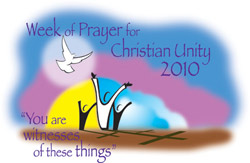 (CCCB)…The Week of Prayer for Christian Unity will be celebrated in Catholic parishes across Canada from 24 to 31 January, 2010.
Inaugurated in 1908 at the initiative of Rev. Paul Wattson, an Episcopalian priest of the United States who would later join the Catholic Church, the event is celebrated all around the world.
(CCCB)…The Week of Prayer for Christian Unity will be celebrated in Catholic parishes across Canada from 24 to 31 January, 2010.
Inaugurated in 1908 at the initiative of Rev. Paul Wattson, an Episcopalian priest of the United States who would later join the Catholic Church, the event is celebrated all around the world.
The Pontifical Council for Promoting Christian Unity, in collaboration with the World Council of Churches, offers a resource for celebrating the Week of Prayer for Christian Unity that includes readings and prayers for each of the eight days of the week inspired by the theme, “You are witnesses of these things” (Luke 24:48).
This year’s theme was chosen by the Churches of Scotland to mark the hundredth anniversary of the 1910 Edinburgh Mission Conference on the theme “Witnessing to Christ Today”, an event largely hailed as the origin of modern ecumenism. “Divisions between Christians,” the gathered missionaries had noted, “not only weaken missionary effectiveness, but the Church and body of Christ and its mission.”
During the 2010 Week of Prayer for Christian Unity, the faithful of the Universal Church are instructed by the resource guide to revisit the Mission Conference’s theme and to reflect on the “appreciation of the resurrection of Christ as the source of ecclesial communion, of being sent out in mission, of the intrinsic link between mission and unity and, therefore, of the continual need to renew our commitment to Christian unity.”
The faithful are also invited to pray for unity among Christians during the course of the Week and year round.
The Canadian Conference of Catholic Bishops is the national assembly of Catholic Bishops who have pastoral responsibility for 12.8 million Catholics across the country. The Conference provides ways for assisting the Bishops of Canada in their common pastoral responsibilities in different areas such as doctrine, ecumenical and interfaith relations, justice and peace issues, liturgy and catechesis. For further information visit: www.cccb.ca
Useful Links
Message from CCCB President Bishop Pierre Morissette, announcing an emergency joint campaign by the CCCB and the Canadian Catholic Organization for Development and Peace in order to respond to the urgent situation in Haiti.
The link to current information on the website of Development and Peace is: http://www.devp.org/devpme/eng/international/haiti-eng.html
The link to the latest information on the work of Caritas in Haiti is: http://blog.caritas.org/
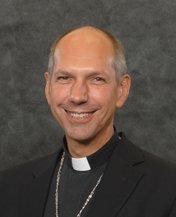 (CCCB – Ottawa) – His Holiness Pope Benedict XVI today appointed Msgr. Donald Bolen as Bishop of Saskatoon, Saskatchewan. The see of Saskatoon had been vacant since the nomination earlier this year of Most Rev. Albert LeGatt as Archbishop of Saint-Boniface.
(CCCB – Ottawa) – His Holiness Pope Benedict XVI today appointed Msgr. Donald Bolen as Bishop of Saskatoon, Saskatchewan. The see of Saskatoon had been vacant since the nomination earlier this year of Most Rev. Albert LeGatt as Archbishop of Saint-Boniface.
Bishop-elect Bolen was born in Gravelbourg, Saskatchewan on February 7, 1961. After earning his B.A. Honours in religious studies at the University of Regina, in 1986, he pursued his education at Saint Paul Seminary in Ottawa, completing a licentiate in theology.
Bishop-elect Donald Bolen was ordained to the priesthood on 12 October, 1991 for the Archdiocese of Regina. Following his ordination, he received several pastoral appointments within the Archdiocese. He also served on the Pontifical Council for Promoting Christian Unity, working in relations with the Anglican Communion and World Methodist Council, from 2001 to 2008.
In November, 2008, he was awarded the Cross of St Augustine by the Archbishop of Canterbury for his service to relations between the Catholic Church and the Anglican Communion.
Since August 2009, he has been serving as Vicar General for the Archdiocese of Regina. The Diocese of Saskatoon has a Catholic population of 86,645 in 98 parishes and missions, served by 49 diocesan priests, 43 religious order priests, three permanent deacons, 182 religious Sisters and Brothers, and 10 lay pastoral workers.
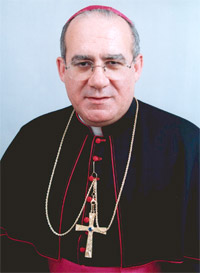 (Ottawa — CCCB) His Holiness Pope Benedict XVI today appointed Most Reverend Pedro López Quintana Apostolic Nuncio to Canada. He was Apostolic Nuncio to India and Nepal since 2003. Archbishop López Quintana succeeds Most Reverend Luigi Ventura who recently became Apostolic Nuncio to France.
(Ottawa — CCCB) His Holiness Pope Benedict XVI today appointed Most Reverend Pedro López Quintana Apostolic Nuncio to Canada. He was Apostolic Nuncio to India and Nepal since 2003. Archbishop López Quintana succeeds Most Reverend Luigi Ventura who recently became Apostolic Nuncio to France.
Archbishop Pedro López Quintana was born in Barbastro, Spain, on 27 July 1953. He was ordained priest on 15 June 1980 and Bishop on 6 January 2003.
Archbishop López Quintana entered the diplomatic service of the Holy See in 1984 and has served in the Apostolic Nunciatures of Madagascar, the Philippines and India as well as in the Secretariat of State of the Holy See, as Assessor for General Affairs.
Archbishop López Quintana holds a Doctorate in Canon Law and speaks five languages: Spanish, Italian, French, English and Portuguese.
Development and Peace
During its 2-3 December meeting, the Permanent Council of the Canadian Conference of Catholic Bishops (CCCB) formed an ad hoc committee to assist the Canadian Catholic Organization for Development and Peace (CCODP) in reviewing its operations.
The Committee, made up of Archbishop Pierre-André Fournier, of Rimouski, Archbishop André Gaumond, of Sherbrooke, Bishop Fred Henry, of Calgary and Toronto Auxiliary Bishop John Boissonneau, will collaborate with Development and Peace on revising its mandate and operational principles in light of the latest papal encyclical Caritas in Veritate. It will also support CCODP in its implementation of the recommendations made this past June by the Committee of Inquiry established by the CCCB to look into allegations concerning five Mexican organizations, which had received project funding from Development and Peace.
The ad hoc committee will report on the progress made by Development and Peace at the 2010 CCCB Plenary Assembly, which will allow the Bishops to decide on future directions.
Life and Family
The Permanent Council also appointed CCCB Vice President Archbishop Richard Smith, of Edmonton, Bishop Ronald P. Fabbro, C.S.B., of London, and Quebec City Auxiliary Bishop Gérald C. Lacroix, I.S.P.X., to an ad hoc Committee on Life and Family. Its mandate is to develop an intermediate and long-term strategy for the promotion of a culture of life and family in Canada and to submit a proposal to the Permanent Council before the 2010 Plenary.
“Catholics have been expressing the need for a stronger and more unified leadership in the areas of life and family,” said CCCB President, Bishop Pierre Morissette. “We are hoping that these initiatives will inspire the faithful to reaffirm their Catholic identity and get involved in creating a culture more respectful of life in its entirety.”
The Canadian Conference of Catholic Bishops is the national assembly of Catholic Bishops who have pastoral responsibility for 12.8 million Catholics across the country. The Conference provides ways for assisting the Canadian Bishops in their common pastoral responsibilities in different areas such as doctrine, ecumenical and interfaith relations, justice and peace issues, liturgy and catechesis.
 (CCCB – Ottawa) – His Holiness Pope Benedict XVI today appointed Most Rev. Brian Dunn, Bishop of Antigonish in Nova Scotia. He was previously Auxiliary Bishop of Sault Ste-Marie in Ontario.
Since the resignation this past September of Most Rev. Raymond Lahey, Most Rev. Anthony Mancini, Archbishop of Halifax and Apostolic Administrator of Yarmouth, had been appointed Apostolic Administrator of Antigonish for the duration of the vacancy, while continuing with his responsibilities for the Archdiocese of Halifax and the Diocese of Yarmouth.
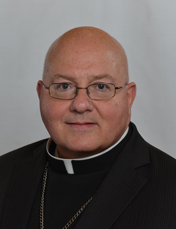 (CCCB – Ottawa) – His Holiness Pope Benedict XVI today appointed Most Rev. Brian Dunn, Bishop of Antigonish in Nova Scotia. He was previously Auxiliary Bishop of Sault Ste-Marie in Ontario.
Since the resignation this past September of Most Rev. Raymond Lahey, Most Rev. Anthony Mancini, Archbishop of Halifax and Apostolic Administrator of Yarmouth, had been appointed Apostolic Administrator of Antigonish for the duration of the vacancy, while continuing with his responsibilities for the Archdiocese of Halifax and the Diocese of Yarmouth.
Since the resignation this past September of Most Rev. Raymond Lahey, Most Rev. Anthony Mancini, Archbishop of Halifax and Apostolic Administrator of Yarmouth, had been appointed Apostolic Administrator of Antigonish for the duration of the vacancy, while continuing with his responsibilities for the Archdiocese of Halifax and the Diocese of Yarmouth.
Bishop Brian Dunn was born in St. John’s, Newfoundland, in 1955 and ordained to the priesthood in 1980. He was then assigned to a number of parishes in the Diocese of Grand Falls until 1988, when he moved to Ottawa in order to complete his Doctoral studies at Saint Paul University. In 1991, he was assigned to parish ministry and also worked as Vice-Chancellor and Chancellor for the Diocese of Grand Falls while teaching theology in the Maritimes. In 2002, he became a faculty member at St. Peter’s Seminary, in London, Ontario. From 2005 until his appointment as Auxiliary Bishop of Sault Ste-Marie in 2008, he had served as Dean of Studies.
The Diocese of Antigonish has a Catholic population of 129,730 in 118 parishes and missions, served by 114 diocesan priests, three priests who are members of religious orders, one permanent deacon and 272 religious Sisters.
(CCCB-Ottawa)… His Holiness Pope Benedict XVI today appointed two Auxiliary Bishops for the Archdiocese of Toronto – Rev. William Terrence McGrattan and Rev. Vincent Nguyen – to assist Most Rev. Thomas Collins, Archbishop of Toronto. Their appointments bring the number of Toronto Auxiliary Bishops to four, joining Most Rev. John A. Boissonneau and Most Rev. Peter J. Hundt.
(CCCB-Ottawa)… His Holiness Pope Benedict XVI today appointed two Auxiliary Bishops for the Archdiocese of Toronto – Rev. William Terrence McGrattan and Rev. Vincent Nguyen – to assist Most Rev. Thomas Collins, Archbishop of Toronto. Their appointments bring the number of Toronto Auxiliary Bishops to four, joining Most Rev. John A. Boissonneau and Most Rev. Peter J. Hundt.
 Born in London, Ontario, on 19 September, 1956, Father William Terrence McGrattan studied at St. Peter’s Seminary, London, Ontario, where he obtained a Masters of Divinity in conjunction with the University of Western Ontario. Following his ordination to the priesthood on 2 May, 1987, Father McGrattan pursued studies in theology at the Pontifical Gregorian University, receiving a licentiate in 1992. Following several pastoral appointments within the Diocese of London, he was appointed Rector of St. Peter’s Seminary, a position he has been holding since 1997.
 Born in Vietnam on 8 May, 1966, Father Vincent Nguyen moved to Canada in 1984. He holds a Bachelor of Applied Science in electrical engineering from the University of Toronto and a Masters of Divinity from St. Augustine’s Seminary in Toronto. He was ordained a priest on 9 May, 1998. He then did further studies in Rome, where he received a licentiate in canon law from the Angelicum. Since September 2009, he has been serving as Chancellor and Moderator of the Curia of the Archdiocese of Toronto.
The Archdiocese of Toronto has a Catholic population of 1,626,465 in 244 parishes and missions, served by 286 diocesan priests, 433 religious order priests, 119 permanent deacons, 651 religious Sisters and Brothers, and 59 lay pastoral workers.
Backgrounder
How a Bishop is selected
At least every three years, the Bishops of an ecclesiastical province meet to draw up a list of priests who are suitable candidates for the episcopate. This discussion is limited to the merits of individual priests proposed by their bishops as possible candidates for the episcopate. After this meeting, the list is sent to the Canadian Apostolic Nuncio (based in Ottawa) who in turn forwards it to the Holy See (Vatican).
When an auxiliary bishop is needed, the diocesan bishop puts forth his own recommendations and prepares a list of at least three candidates from either inside or outside of the diocese. He sends this to the Apostolic Nuncio, who in turn forwards it to the Holy See, after reviewing the list and adding his own opinion. This list can incorporate candidates from his own diocese, candidates discussed by the bishops of the ecclesiastical province to which he belongs or he may suggest names of possible candidates for the first time.
The ‘terna’ is the shortlist of three names determined by the Holy See. After the terna has been decided, the papal representative, the Apostolic Nuncio, is instructed to commence an extensive investigative process on the Episcopal suitability of each of the candidates on the terna. On average, this process may take two to six months. Confidential advice is sought through letters and other documentation from those who have worked closely with the proposed candidate. When the Apostolic Nuncio has concluded his investigative process he forwards his final report containing his recommendation to the Holy See, usually to the Congregation of Bishops.
The primary responsibility of the Congregation of Bishops is to examine all the documentation presented to the Holy See by the Apostolic Nuncio and to advise the Holy Father, who alone decides the appointment of a bishop. The Congregation fulfills this function by meeting in a session where the documentation gathered by the Apostolic Nuncio is presented. Several Episcopal appointments from throughout the universal church may be discussed at this one meeting. The advice of the Cardinal Prefect and Bishop members of the Congregation is then communicated to the Holy Father. At a later time, the Holy Father makes his decision. In reaching his decision the Holy Father is not bound by the advice presented to him.
After the pope has made his decision the Prefect for the Congregation of Bishops informs the Papal Nuncio of his decision, who in turn, contacts the appointed candidate to ask if he will accept the appointment. Through a letter, the Papal Nuncio officially informs the Bishop and the candidate of the appointment, requesting strict confidentiality of the information until the Vatican makes the announcement.